 English
 Čeština
BLAC and White framework
We're building a comprehensive knowledge library about product development as part of our mission. The library is for anyone looking to make better decisions — primarily decisions about how to further develop a product. Whether you're an inventor, a product manager, or a Chief Product Officer, using a structured decision-making method increases your chances of building the right things for the right audience (build the right thing for the right audience). Today we'll introduce the BLAC and White framework.
Framework name: BLAC and White.
Inventor: Michael Skok.
Year first used: 2013.
Link to original research: the Harvard i-lab presentation Startup Secrets: Value Proposition and the presentation associated with the framework.
Key figures in developing the framework:
Underscore VC (co-founder Michael Skok)
The Harvard Innovation Lab (The Platform)
Key milestones in developing the framework:
Unknown.
History and First Use
The framework aims to surface problems that are blatant while also being critical, and that have a gap in the market around them (White). Michael Skok showed that certain problems are worth solving first. These are the problems that need solving immediately, because they're critical to a given business at that very moment. This method is especially typical of the B2B market. Skok stated outright that failing to solve these problems "threatens the company's reputation and the careers of the people who work in it."
The Basic Principle of Prioritization
The core idea of the matrix is to determine whether the problem you're solving is critical and blatant, while also having enough room around it to build a commercial solution that can be defended in a competitive environment.
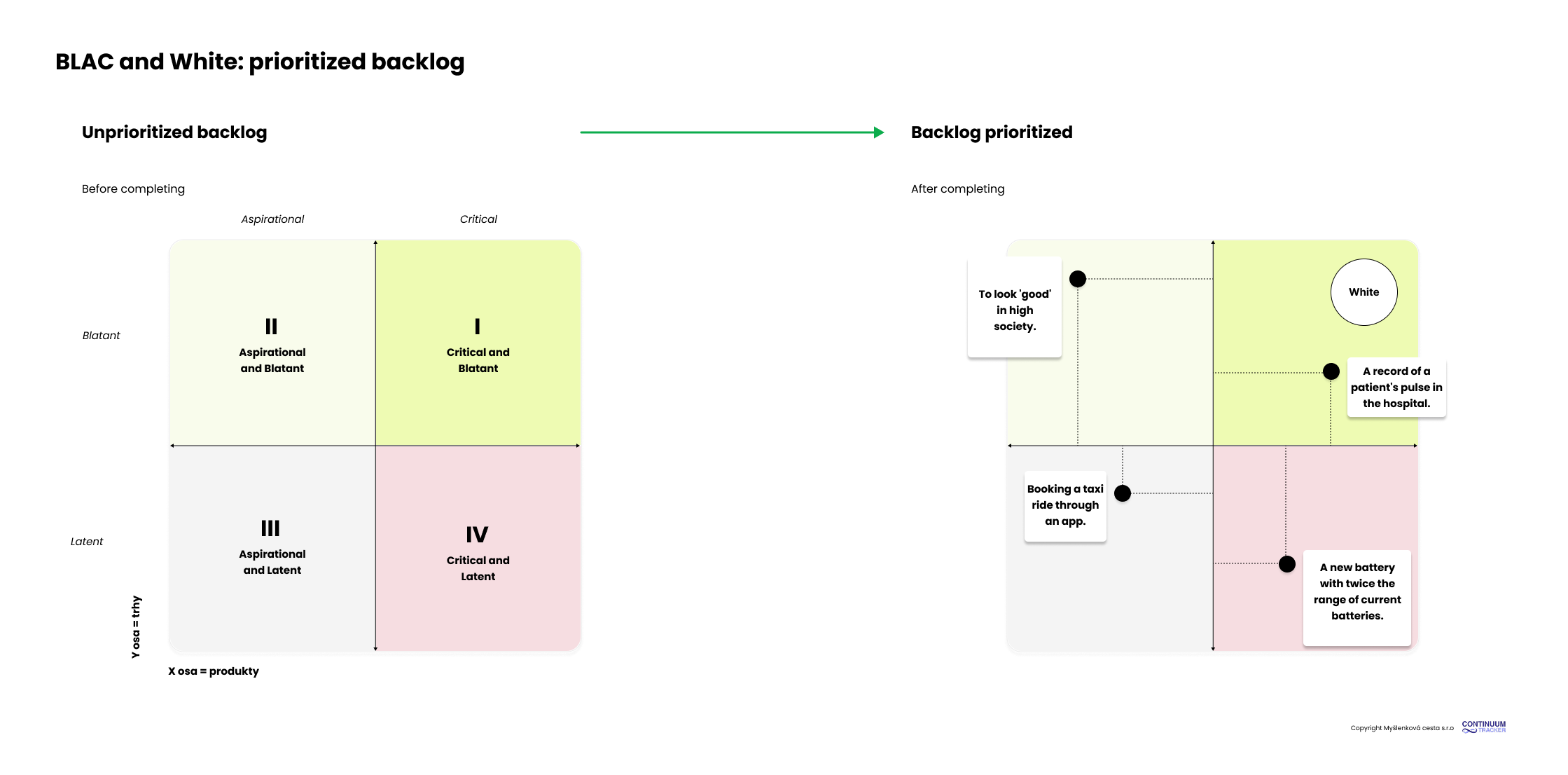
The matrix has two axes and four quadrants representing the four possible product problems worth focusing on:
Aspirational/Critical = The X axis shows how critical the problem is. Criticality is a subjective assessment of the need. The value can be aspirational or fully critical — or somewhere in between — depending on the impact that satisfying it has on the business or the individual.
Blatant/Latent = The Y axis shows how obvious the problem is. The value can be blatant or fully latent — or somewhere in between — depending on the time pressure that satisfying it puts on the business or the individual.
The matrix includes an additional condition called White, which appears only in Quadrant I. White means that a critical and blatant problem is undervalued by the market. In other words, it has the following qualities:
there's a "white" gap in the market — an open opportunity for a new product,
which the solver can capture through a solution,
and defend that solution,
using a unique value proposition in the market.
If a problem falls into the critical and blatant category, finding a solution is worth considering, because market interest can be expected. And if the problem also meets the White conditions, then solving it has a shot at exponential revenue growth.
A Prioritization Example
An example of prioritizing selected problems using the BLAC and White framework.
Quadrant I — Critical and Blatant Problems
The "top-right" quadrant represents what are called Critical and Blatant problems. These are extremely urgent problems with a high degree of criticality to the business or the individual. They represent potentially interesting opportunities to build a commercially successful product around.
If a problem in this quadrant also meets the White conditions, then solving it has a shot at exponential revenue growth.
Quadrant II — Aspirational and Blatant Problems
The "top-left" quadrant represents what are called Aspirational and Blatant problems. Problems in this category are highly visible, but they can't be turned into a commercially sellable solution that customers will pay for.
Quadrant III — Aspirational and Latent Problems
The "bottom-left" quadrant represents what are called Aspirational and Latent problems. This set of problems is a common starting point for entrepreneurs, but their solutions are hard to push through with end customers. Problems in this quadrant require constant "selling" effort from the founders toward end users.
Through effective execution of a commercial product around the need, it's possible to move this type of problem into the blatant and critical category, and thereby increase the product's chances of long-term commercial success.
Latent problems are often consumer in nature, so their commercial solutions are aimed at the B2C market.
Quadrant IV — Critical and Latent Problems
The "bottom-right" quadrant represents what are called Critical and Latent problems. You don't hear about these problems as much in society, but once they surface, they're extremely important.
A Prioritization Example
Quadrant I — Critical and Blatant Problems
The need to correctly record a patient's pulse in a hospital, because their life depends on it.
The need to record a quality inspection for newly manufactured cars, because if that audit is missing, the manufacturer has to recall the cars for repair, which costs millions of dollars.
Quadrant II — Aspirational and Blatant Problems
The need to look "good" in high society is a very real, blatant feeling, but satisfying it is purely aspirational — it isn't bound by time, penalties, high costs, or any impact on human life.
Quadrant III — Aspirational and Latent Problems
Uber and its taxi-booking product is the best example of this category. Interestingly, thanks to strong management execution, Uber moved out of this quadrant into Quadrant I and became critical and blatant.
Quadrant IV — Critical and Latent Problems
An example of this category is the need for a new battery with twice the range of current ones. This need is certainly critical for the mass adoption of electric vehicles, but because today's batteries are good enough for both carmakers' revenue growth and consumers' needs, it isn't all that obvious at first glance.
Visual example of prioritization