Product development

Product prioritization inspired by research on decision-making under uncertainty

We are building product prioritization technology based on behavioral economics for a world where speed is expected and copying is effortless and cheap. Our system helps teams evaluate millions of potential product directions and make better decisions about what to build next in an environment of endless possibilities.

  • Idea shopping
  • Decision ownership
  • Fast and slow thinking
  • AI as a devil's advocate
Based on behavioral economics Fully AI agentic

Based on Nobel Prize–winning research on decision-making under uncertainty

A product manager combines fast and slow thinking. They quickly select directions from a pre-prepared, prioritized list of user problems, then explore them with the help of AI. In this process, AI acts as a "devil's advocate", helping them deeply understand the underlying user problem.

Through this process, the product leader quickly separates what works from what doesn't—and takes full ownership of the decisions that follow.

80% rule

A product manager applies fast thinking. The goal is to quickly select possible directions for further development with minimal cognitive effort (System 1). The only criterion for selection is alignment with the company's goals.

The product manager automatically receives a prioritized list of user pain points from AI.

Based on experience and tacit knowledge of the product domain, they quickly select what to further explore. We call this idea shopping—the creation of a narrowed-down list of potentially interesting ideas.

20% rule

A product manager applies slow thinking. The goal is to develop a deep understanding of user pain points, which requires cognitive effort (System 2).

The product manager "chats" with pain points to deeply understand the user problem and evaluate its traction. In this process, they often find that some pain points are not worth solving.

Our AI chat is pre-loaded with context for each specific pain point, including whether and how it has been addressed before. It acts as a "devil's advocate" for the product manager—challenging assumptions and helping ensure a deep understanding of the user problem.

Taking ownership of the decision

The final step is presenting the selected pain points for development to stakeholders. The goal is to take ownership of the decision, test the messaging, and create alignment across the company.

The product manager uses AI to prepare a presentation that clearly shows why the pain point matters and how solving it supports the company's goals.

In very flat management structures, instead of a presentation, the product manager adds the item directly to the roadmap, giving the decision real weight.

Daniel Kahneman, decision-making under uncertainty. Link: https://www.nobelprize.org/prizes/economic-sciences/2002/kahneman/facts/

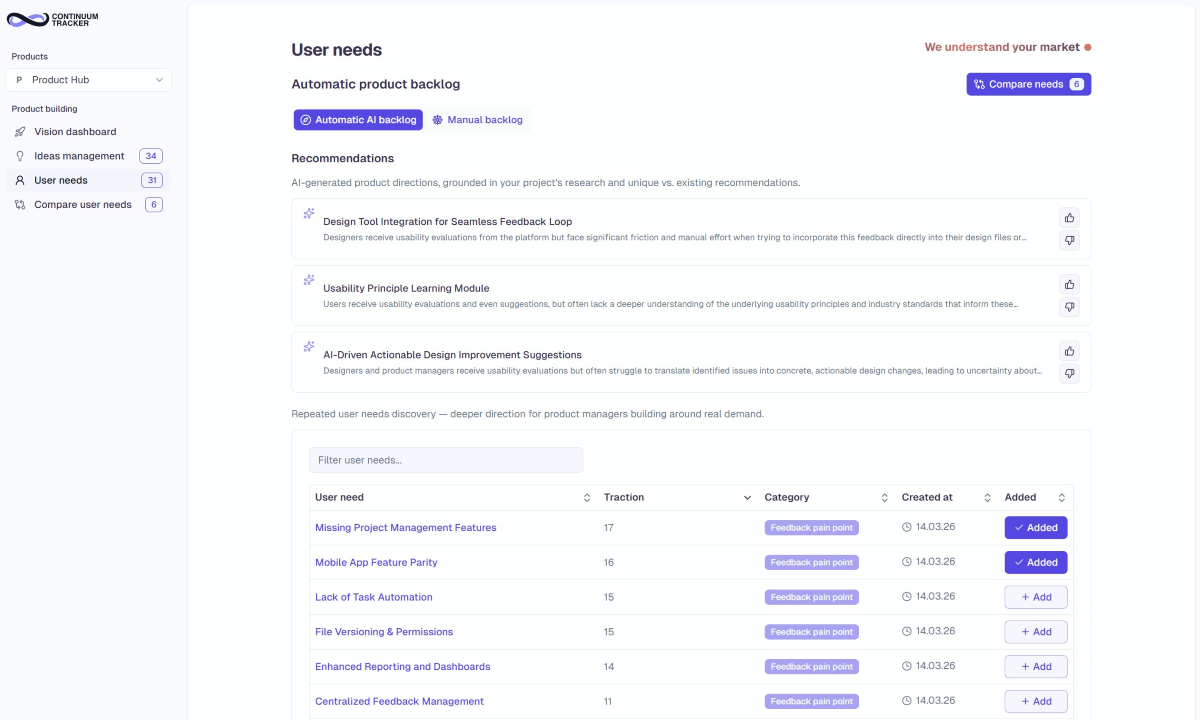
Continuum Tracker backlog dashboard

Human product decision-making using AI is like online shopping

Identifying pain points that are strong enough to drive a company's product goals is a time-consuming and complex task in product strategy.

Continuum Tracker automatically links pain points to specific development opportunities and organizes them in a structured backlog, allowing you to focus on product strategy.

Problem discovery

AI automatically finds user pain points in the company's data and structures them by importance.

Selecting opportunities

AI automatically shows the traction of user pain points.

Deeper understanding and decision

AI works like a "devil's advocate" — it helps challenge product hypotheses, uncover context, and understand the user problem in depth.

Automating product management

Introducing agentic AI product management

Agentic AI product development unites fast and slow thinking to make prioritization faster and more accurate. Here's how it pays off. Speed turns a customer pain point into a working prototype in minutes, not hours. Auditability captures the reasoning behind every decision and every prototype change, so you can backtrack it and sharpen future judgment. Automation of fast thinking gives you back the weeks that synthesis used to swallow.

How do we start with agentic AI product development? Your LLM needs good context about your business problems to make good proposals. Continuum Tracker keeps that context in sync in the background — so you and your agents always decide with the full picture.

> /plugin marketplace add development-continuumtracker/prioritization-skills-continuumtracker
> /plugin install continuum-tracker@continuumtracker

Run both commands inside Claude Code.

what are my priorities? Called 1 tool, ran 2 shell commands Verified auth. You have 14 products in Continuum Tracker — here are yours, alphabetically.
#ProductVision
1Nova CardSpending that makes sense the moment it happens. Every purchase categorised before you close the app.
2Nova Crypto(no vision set)
3Nova ExchangeSend money across a border for the price of a coffee, at the rate you were actually quoted…
4Nova InsuranceCover that switches on when you land and off when you get home. Insurance you never think about.
5Nova JuniorPocket money that teaches. Children learning what things cost before the first real salary.
6Nova PartnershipsTo put the account where people already are — the airline, the retailer, the phone contract.
7Nova PremiumOne subscription that quietly removes the fees, the queues and the paperwork from every other Nova product.
8Nova SavingsA rainy-day fund that fills itself from the rounding on every purchase.
9Nova StaysBook the trip from the same place you paid for it. Travel money and travel plans stop being separate…
10Nova TeamsOne shared account for a small business, with the documents, approvals and permissions in one place.
11Nova TransfersSplitting a bill should end the conversation, not start one…
Which product should we work on today? Answer with a number. ✻ Crunched for 40s

This terminal replays an illustrative example for a digital product. Nova Stays and its features are a hypothetical product, and the real output will differ depending on your own product, data and setup.

The development process

The machine ranks the product enhancements (fast thinking), the human evaluates (slow thinking).

    • Human review — gate keeping
    • Human review — gate keeping
    • Human review — gate keeping
    • Human review — gate keeping
    • Run many product agents in parallel to maximise the chance of hitting the goal

How did the process change in agentic AI product development?

Agentic AI product management creates new tasks on both sides: the machine generates and ranks the options, the human makes the case for the right one to the people who have to back it.

Role of the machine

Analyses vast amounts of data to produce possible product directions, then sorts them by traction. This is fast thinking, at a volume and speed that no human can match anymore.

Role of the human

The gate-keeper. Judges which options move business outcomes, then does the work only a human can: growth hacking, securing buy-in and presenting the decision.

Long horizon task — experimental

Completely autonomous product development using AI

The next step in automating product development is handing the whole thinking loop to the AI. In a long-horizon run it takes a customer pain point, drafts the opportunity and builds the product with no human review between the steps — gate keeping happens once, at the end. The goal and vision you supply keep it on course. Goals are usually financial such as more sign-ups, higher revenue.

For now this is purely experimental, and our end goal. The AI runs unattended for hours and optimizes for the vision and the goals given in the product domain.

Set the vision and the goals

This is how you want to change the world.

continuum run --unattended --vision @novastays --goal "600 sign-ups / month"
Thought for 41s
Nova Stays puts travel booking inside the account that already holds the money — you book the trip from the same place you paid for it, so travel money and travel plans stop being separate. The goal is 600 sign-ups a month. Every major action is audited against the customer and the market data before the next one starts.
Read continuum://nova-stays/brief
Vision — book the trip from the same place you paid for it
Goal — 600 sign-ups a month, the north star every step below is scored against
Task Understand the customer pain points
32 user needs · 140 connected data items · 22 verbatim quotes12.4s
Re-ranked by modelled lift on sign-ups · 27 dropped as off-goal8.7s
Proposal work on Cancellation Terms Before Payment
Top of the re-ranked list · 28 evidence items · the largest modelled lift on sign-ups of the five that survived6.2s
Spawning 2 agents concurrently — the audit loop on the proposal, one per body of evidence
Task(Audit against customer evidence)
Running… · 24 tool uses · ↑ 18.2k tokens · 1m 04s
Task(Audit against market data)
Running… · 19 tool uses · ↑ 15.7k tokens · 1m 04s
Loop 12 claims dropped, the evidence under them was too thin
Loop 2re-read against 3 competitor booking flows · the ranking holds
Thought for 1m 12s
Travellers burned once by a non-refundable rate leave before they pay. Against a goal counted in sign-ups, that is the largest single block of people the product is losing, so the page has to name the cancellation deadline before the card is charged.
Task Draft the opportunity
User story, acceptance criteria and the measure that counts, all tied to the goal9.6s
3 solution directions drafted and scored against the goal · 2 dropped13.2s
Proposal show the cancellation deadline and the real refund before the card is charged
Scoped to the booking flow · 3 files to change, no schema migration7.4s
Spawning 3 agents concurrently — one per piece of the build. None of them waits on another.
Task(Build the suggested journey)
Running… · 31 tool uses · ↑ 22.4k tokens · 1m 18s
Task(Refund shown in the home currency)
Running… · 12 tool uses · ↑ 14.1k tokens · 58s
Task(Regression-check the booking flow)
Running… · 8 tool uses · ↑ 8.7k tokens · 41s
14 files written · 3 revisions, each scored against the goal
Audit the product against the customer and market data
Loop 1replayed against the 28 evidence items · revision 1 contradicted 4 of them11.7s
Loop 2rebuilt, replayed · every claim on the page traces back to a quote14.3s
Loop 3read against 3 competitor flows · nothing on the page overpromises7.8s
Thought for 22s
Naming the deadline before payment is the only revision that survived every audit loop and moved the modelled sign-ups. The other two are dropped, and nobody is asked.
Task Audit the product development decisions
41 decisions recorded · 7 audit loops · 6 claims dropped along the way
Spawning 2 agents concurrently — the hand-over, one per document. Neither waits on the other.
Task(Write the PRD)
Running… · 21 tool uses · ↑ 19.6k tokens · 18.2s
Task(Build the management presentation)
Running… · 14 tool uses · ↑ 12.3k tokens · 11.4s
PRD and presentation ready to hand to management · every slide traced to a decision above
Run complete 4 h 12 m unattended · 0 human reviews
Handing over the product and the whole trail behind it.
Digital products

The finished product with its features

The whole product waiting on a pull request, built out feature by feature with the technical challenges already solved. Presentation for management is ready.

Physical products

A specified PRD for R&D teams

The whole product in one brief document, held together by a management presentation.

This terminal replays an illustrative example for a product. Nova Stays and its features are a hypothetical product, and the real output will differ depending on your own product, data and setup.

Innovate process and technology at the same time

Increase the quality and speed of product management decision-making today.

Sign Up for Beta