 English
 Čeština
Urgency vs. Importance Matrix framework
We're building a comprehensive knowledge library about product development as part of our mission. The library is for anyone looking to make better decisions — primarily decisions about how to further develop a product. Whether you're an inventor, a product manager, or a Chief Product Officer, using a structured decision-making method increases your chances of building the right things for the right audience (build the right thing for the right audience). Today we'll introduce the Urgency vs. Importance Matrix framework.
Framework name: Urgency vs. Importance Matrix.
Inventor: Stephen R. Covey.
Year of first use: 1989 as a formal framework. The concept appeared informally in 1954 as part of a speech by U.S. President Dwight David Eisenhower to the World Council of Churches.
Link to the author's original research: The 7 Habits of Highly Effective People (1989), First Things First (1994), World Council of Churches Eisenhower speech.
Key figures in the framework's development:
David Dwight Eisenhower,
Stephen R. Covey,
Roger Merrill & Rebecca R. Merrill
Peter Drucker
Key milestones in the framework's development:
The popularization of prioritizing by urgency and importance by the U.S. President in 1954.
Formalization into a 2x2 structure for time-management purposes in the books The 7 Habits of Highly Effective People (1989) and First Things First (1994).
History and Context of First Use
In his book The 7 Habits of Highly Effective People (1989), Stephen R. Covey argues that people spend their time based on the urgency and importance of individual tasks. The tasks they carry out are either urgent, characterized by words like "now" and "right away" and often unimportant, or important, meaning those that contribute to fulfilling a personal mission, values, and often goals. A combination of both is of course possible.
As one of a leader's key habits, Covey points to a way of thinking in which any activity always begins with a picture of the end state. When that state is unknown, leaders often focus on urgent but unimportant tasks and fail to reach their real goals.
Basic Prioritization Principles
The core idea of the matrix is to work on tasks that are important. The matrix shows where to invest our limited time. The matrix is not designed specifically for product development. We can say, however, that it lets us direct our attention toward developing important products or features rather than urgent ones.
The matrix has two axes and four quadrants that represent four ways to prioritize our time:
Urgency = The X axis shows the urgency of a given task, a product or a feature within a product-development prioritization.
Importance = The Y axis shows the importance of a given task, a product or s feature within product-development prioritization.
Both metrics are entirely subjective. Once assessed, a simple 2x2 prioritization matrix emerges, where each quadrant has a specific purpose. Certain types of tasks fall into each quadrant.
Quadrant I - Plan
The "top-right" quadrant represents Plan and embodies tasks that are urgent and important at the same time. We often call these crises and problems.
Here we find tasks tied to deadlines and tasks with a significant impact on our goals.
Quadrant II - Do
The "top-left" quadrant represents Do and is the center of "effectiveness." It holds activities that are not urgent but are important.
Here we find activities oriented toward the future and long-term goals. This quadrant is heavily future-oriented.
Quadrant III - Delegate
The "right" quadrant represents Delegate and contains unimportant but urgent tasks.
This quadrant holds tasks that don't require the owner's attention and can be carried out by someone else.
Quadrant IV - Eliminate
The "bottom-left" quadrant represents Eliminate and contains unimportant and non-urgent tasks.
We try to avoid this quadrant, because it holds tasks that only keep us from our long-term goal.
Prioritization Example
Quadrant I - Plan
Fixing critical bugs, resolving a critical security flaw, or high customer churn.
Outside product management, this quadrant covers deadline-related matters, problems instead of solutions, stressful situations, burnout, and a sense of crisis.
Quadrant II - Do
Product discovery — uncovering new, unrecognized customer needs. Activities tied to prevention and planning.
Outside product management, this quadrant covers relationship building, personal goals, long-term planning, spotting new opportunities, personal hygiene such as regular exercise, setting visions, and similar tasks.
Quadrant III - Delegate
Developing requirements according to the CEO.
Outside product management, this quadrant covers a focus on short-term goals, seeking reputation, viewing plans and goals as unnecessary, and a feeling of loss of control.
Quadrant IV - Eliminate
Updating technical libraries to the latest version when our platform is on the second-newest.
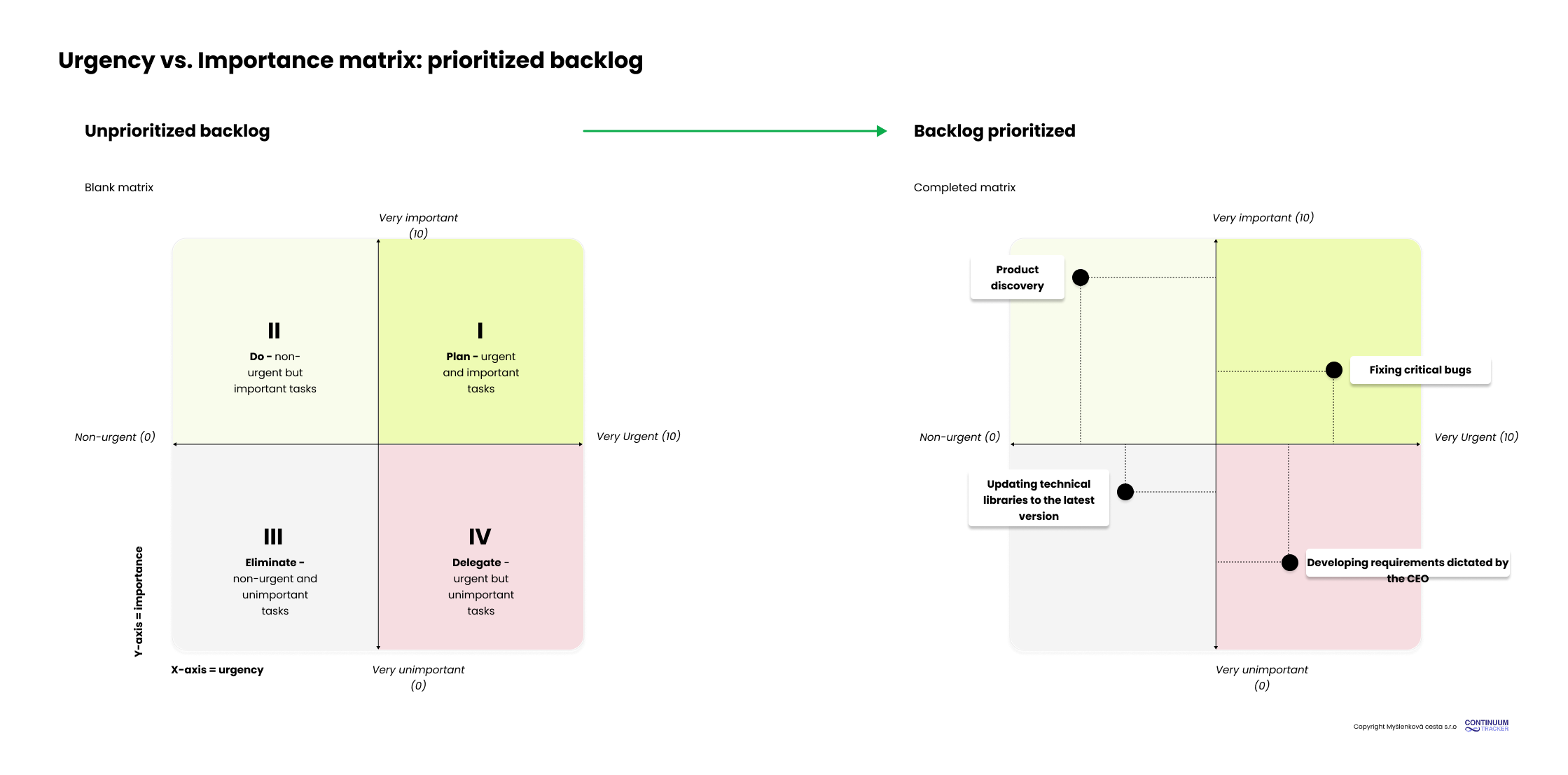
Visual Prioritization Example