 English
 Čeština
Top Tasks framework
We're building a comprehensive knowledge library about product development as part of our mission. The library is for anyone looking to make better decisions — primarily decisions about how to further develop a product. Whether you're an inventor, a product manager, or a Chief Product Officer, using a structured decision-making method increases your chances of building the right things for the right audience (build the right thing for the right audience). Today we'll introduce the Top Tasks framework.
Framework name: Top Tasks.
Inventor: Gerry McGovern.
Year of first use: 2003, according to this blog post.
Link to the author's original research: Unknown.
Key figures in the framework's development:
Kathryn Cullen,
Donna Spencer,
Paul Boag.
Key milestones in the framework's development:
Adoption of Top Tasks into various UX testing frameworks
The book Top Tasks – A How-To Guide (2018) (link)
History of First Use
Gerry McGovern developed the Top Tasks method after years of analyzing large organizations' websites, where he found that most of the content goes unnoticed and unused.
The goal of the framework is to find out what people actually want to do on a website or in a product, not what the organization thinks is important.
Top Tasks helps teams focus on the handful of key tasks that account for most of the user value, and eliminate content or features that don't deliver it.
Basic Prioritization Principles
Top Tasks is a method for identifying and measuring the most important user tasks. It combines quantitative research (user voting) with qualitative observation (measuring success rates).
Process:
Collect a list of tasks – 50 to 100 potential tasks a user might want to perform.
Base it on real data:
website search analysis,
customer support queries,
analytics (e.g. most visited pages),
user interviews,
input from team members (e.g. sales, marketing, development).
Each task should be phrased as an activity – for example "find the product price", "download the specification", "submit a complaint".
User voting – hundreds to thousands of respondents choose what matters most to them. Participants usually pick the five most important tasks they'd want to perform on the website or in the product. The result is a ranking by vote count – a clear view of what users genuinely consider important.
Identify the Top Tasks – once the votes are evaluated, they separate into:
Top Tasks – the 5 to 10 tasks with the most votes,
Tiny Tasks – the long "tail" of remaining, less important tasks.
Top Tasks typically make up about 5% of all tasks but account for 80–90% of the user/product value (source: Gerry McGovern, Top Tasks – A How-To Guide, 2018).
Test and measure performance – once the Top Tasks are known, the team can test how easily users complete them. It's not just whether the task can be done, but how long it takes and how many mistakes people make along the way.
The most common testing methods are:
Tree Testing – testing the information structure,
Usability Testing – measuring task completion rates,
Benchmarking – repeated tests over time to see whether performance improves.
The result is an overview of which key tasks need improvement, and what impact that has on overall user satisfaction.
Prioritization Example
A fictional team is redesigning a university website. The goal is to find out what students and applicants look for most often, so the site matches their real needs.
The team collects 60 possible tasks from interviews, analytics, and support tickets. Voting then takes place among 1,200 respondents.
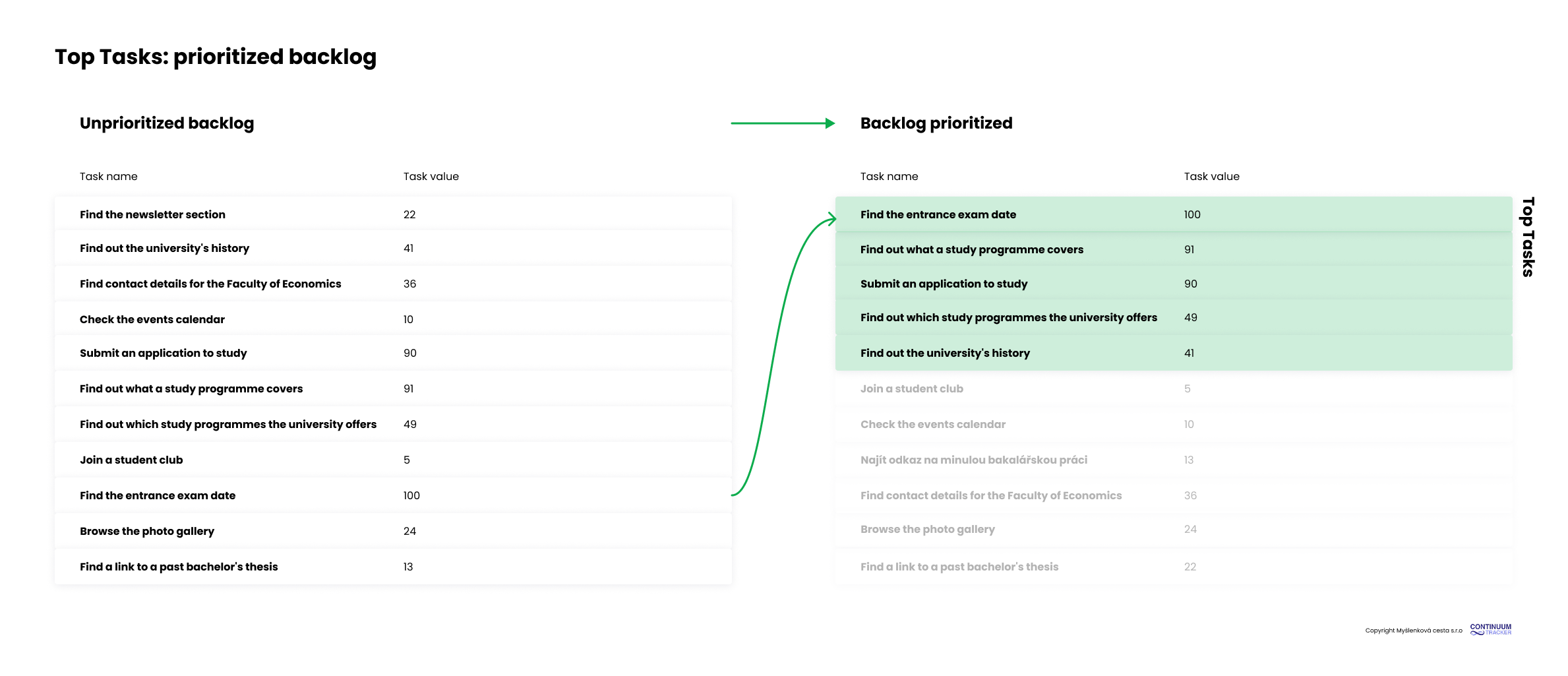
Visual prioritization example
Applying the method showed that the vast majority of visitors come for a few clear tasks: finding information about programs, applying for a course, and locating entrance exam dates.
These tasks form the core of the website. They are so called Top Tasks.
The rest, such as the university's history or the photo gallery, are Tiny Tasks and can be moved to less prominent sections.