 English
 Čeština
The Hundred-Dollar Test framework
We're building a comprehensive knowledge library about product development as part of our mission. The library is for anyone looking to make better decisions — primarily decisions about how to further develop a product. Whether you're an inventor, a product manager, or a Chief Product Officer, using a structured decision-making method increases your chances of building the right things for the right audience (build the right thing for the right audience). Today we'll introduce the 100 points framework.
Framework name: The Hundred-Dollar Test
Inventor: Unknown, but attributed to Dean Leffingwell and Don Widrig
Year of first use: 1999
Link to the author's original research:
Book, Managing Software Requirements: A Use Case Approach (1999)
Key figures in the framework's development:
Dean Leffingwell,
Don Widrig,
Tobias Hildenbrand,
Michael Geisser,
Sven Scheibmayr
Patrik Berander,
Anneliese Andrews.
Key milestones in the framework's development:
Iteration on the evaluation criteria (number of evaluation rounds, feasibility of the solution, and others)
Integration into agile development
Academic research on the technique:
History of First Use
Dean and Don were looking at how to narrow down the ideas that come out of brainstorming in software development, and proposed a simple prioritization technique called The Hundred-Dollar Test, based on technique called cumulative voting.
Basic Prioritization Principles
The Hundred-Dollar Test is a method for identifying the most important features. It is similar to the Buy a Feature framework.
The prioritization requires the stakeholders to be in one room. These can be customers, or — in the case of internal software development — key people within the company.
The other artifact this test needs is a list of features that are "for sale". These features most often come out of brainstorming sessions, and are then grouped and defined in more detail. The brainstorming may or may not be part of the prioritization session itself. If the brainstorming process isn't part of the session, the facilitator explains to all participants which features are for sale, so that everyone understands their value.
Each person is given a fictional $100 to "spend" on the predefined features. The buyers' task is to spend all $100. The facilitator then records each purchase in a table.
The method has two limits:
It cannot be repeated on the same set of features with the same people, because knowing the resulting ranking influences their preferences. Participants automatically develop a bias toward that ranking.
The other important aspect is capping the maximum purchase price of a single feature. This keeps individual participants from going "all-in" on their favorite features.
The features with the highest dollar totals — the dollars are often referred to as votes — carry the greatest added value. Those features become the winners of the prioritization.
Prioritization Example
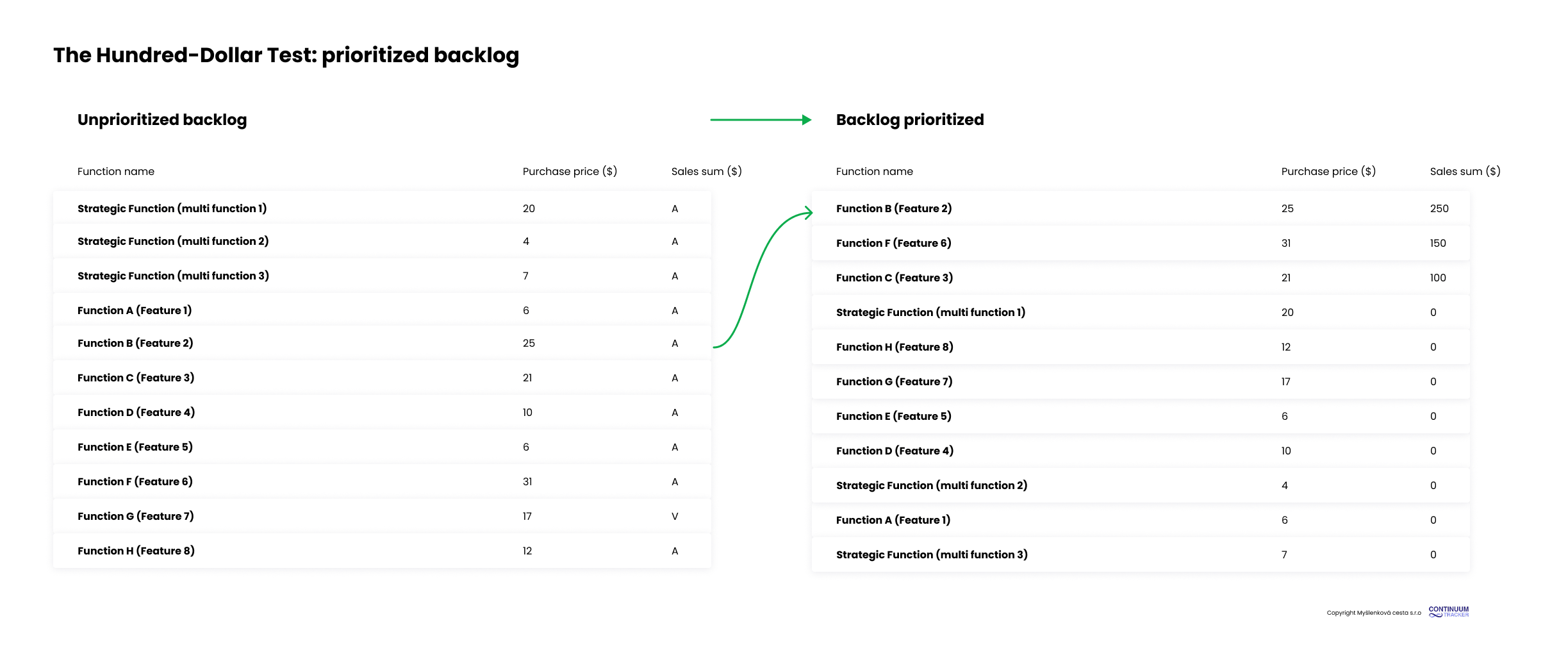
We have 5 stakeholders, and therefore a total of $500 in fictional money in circulation.
List of features for sale
Price $25: Adding Apple Pay to the e-shop checkout,
Price $10: Adding product variants to the product card (for example Coca Cola 1 l, 2 l, 4 l, and 250 ml),
Price $20: Adding favorite items to the app menu.
Final ranking
Total sales of $250:
Adding Apple Pay to the e-shop checkout.
Total sales of $150:
Adding product variants to the product card (for example Coca Cola 1 l, 2 l, 4 l, and 250 ml).
Total sales of $100:
Adding favorite items to the app menu.
Visual Prioritization Example
Other Names for the Framework
100 Dollars
100$ voting
The Hundred-Dollar Test
Cumulative voting