 English
 Čeština
Buy a Feature framework
We're building a comprehensive knowledge library about product development as part of our mission. The library is for anyone looking to make better decisions — primarily decisions about how to further develop a product. Whether you're an inventor, a product manager, or a Chief Product Officer, using a structured decision-making method increases your chances of building the right things for the right audience (build the right thing for the right audience). Today we'll introduce the Buy a Feature framework.
Framework name: Buy a Feature.
Inventor: Luke Hohmann.
Year of first use: 2006.
Link to the author's original research:
Book, Innovation Games: Creating Breakthrough Products Through Collaborative Play (2006)
Article Buy a Feature
Key figures in the framework's development:
Innovation Games® team
Key milestones in the framework's development:
Integration into agile development
Connection with the 100 Dollars framework
History of First Use
Buy a Feature is an innovation game that helps product managers make better decisions about which features to build next. Its author, Luke Hohmann, noticed that such decisions often leave end customers out, so he used the game to bring them into the product prioritization process and improved the quality of the decisions in doing so.
Product managers assume that customers have clear priorities about the features they want. But when managers show customers a set of features that could be built, customers usually want all of them. Customers deliberately leaves the decision to the product leader. The same principle of deferred responsibility applies in one-on-one interviews. The customer simply doesn't want to prioritize — and it isn't their job.
Basic Prioritization Principles
The framework works with a group of customers and observes how they prioritize as a group when resources are limited. Maximizing interaction between users is the ultimate goal. The game watches customers negotiate over individual features, which exposes exactly the psychological aspect of comparing feature value through the customer's perspectives that product leaders so often lack.
Preparing the Game
Assemble a group of customers who use the product in a similar way.
Write up the features that are "for sale":
Ideally 14–30 features,
Each feature has a name, a description, and a list of benefits.
Price the features that are "for sale". The goal of pricing is to maximize interaction with users, not to maximize the fictional capital collected for a given feature. Recommendations for this step:
Company-wide strategic features can carry a lower price,
Development cost can be used for pricing.
The number of requests for a given feature can be used,
Value-based pricing is the best method, but it is hard to pull off in practice because the value is often unknown.
Decide how much "money" will be in circulation for the fictional purchasing. The general recommendation is to put in an amount that allows roughly 30–60% of all features to be bought.
Decide how many people will take part in the experiment. Recommendations for this step:
In a B2B setting, more than one representative of a large, strategically important customer should take part,
Several groups of 3–7 people work better, because they can be compared against each other,
If several customers from the same company take part, split them into different groups.
Decide who facilitates the whole process.
How It Runs
The facilitator explains the rules of the game to the fictional buyers, helps keep the game moving, and records the individual purchases and the conversations between people. The facilitator also announces up front that the features fictionally offered for sale in the game may appear in the final product. The buyers — the customers — then buy individual features at the set prices and discuss among themselves which features bring them the most value.
Evaluation
Evaluating the game comes down to looking for patterns in buying behavior across the groups of customers. Repetition of a particular buying pattern is key. If a feature was bought by several customers across different groups, it is seen as important. The conversations that take place between participants while buying these features can also be assessed qualitatively.
Prioritization Example
For this prioritization example we have 5 key people and therefore 376 fictional dollars in circulation.
List of features for sale
Price $15: Adding Apple Pay to the e-shop checkout
Price $32: Adding product variants to the product page (for example Coca Cola 1 l, 2 l, 4 l, and 250 ml)
Price $63: Adding favorite items to the app menu
And 11 more features
Evaluation
Total sales of: $100:
Adding Apple Pay to the e-shop checkout
Total sales of: $57:
Adding product variants to the product page (for example Coca Cola 1 l, 2 l, 4 l, and 250 ml)
Total sales of: $36:
Adding favorite items to the app menu
And 11 more features
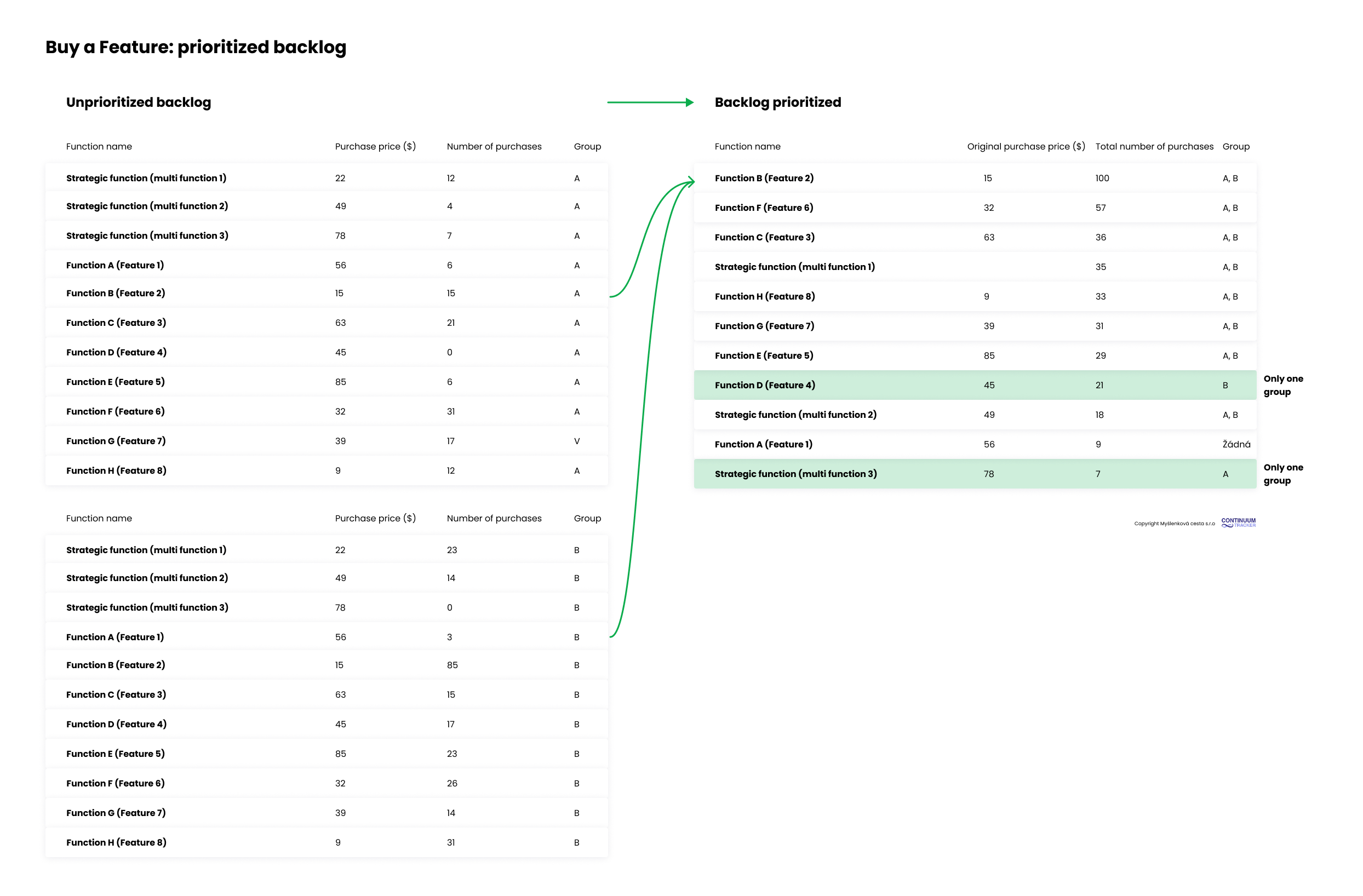
Visual prioritization example