 English
 Čeština
Flywheel (Attract, Engage, Delight).
We're building a comprehensive knowledge library about product development as part of our mission. The library is for anyone looking to make better decisions, primarily decisions about how to further develop a product. Whether you're an inventor, a product manager, or a Chief Product Officer, using a structured decision-making method increases your chances of building the right things for the right audience (build the right thing for the right audience). Today we'll introduce the Flywheel framework.
Framework name: Flywheel (Attract, Engage, Delight).
Inventor: HubSpot.
Year of first use: 2018.
Link to the author's original research: Brian Halligan, Replacing the Sales Funnel with the Sales Flywheel, Harvard Business Review (2018). HubSpot's Flywheel model. Jon Dick, How the Flywheel Killed HubSpot's Funnel.
Key figures in the framework's development:
Brian Halligan, co-founder of HubSpot
Jon Dick, who led HubSpot's flywheel marketing team and documented how HubSpot rebuilt itself around the flywheel.
Key milestones in the framework's development:
Jim Collins introduces the flywheel as a management idea in Good to Great in 2001. Great companies build momentum through many consistent pushes in one direction. His flywheel has no fixed stages, and each company defines its own.
In autumn 2001 Amazon invites Collins and sketches its own flywheel of prices, traffic, sellers and selection.
Brian Halligan and Dharmesh Shah found HubSpot in 2006 and coin the term inbound marketing. Its inbound methodology moves people from strangers to customers through a funnel.
At INBOUND 2018 Halligan retires the funnel, replaces it with a flywheel of Attract, Engage and Delight, and explains the switch in Harvard Business Review.
In 2025 HubSpot launches Loop Marketing, a four stage cycle in which people and AI work together.
At How to Web 2026 HubSpot presents a six part Agentic Loop that puts AI agents into every stage of the flywheel.
History of First Use
Before HubSpot’s formulation of the flywheel in 2018, the flywheel was a general set of principles that Jim Collins taught Amazon to help grow its business. HubSpot then built the inbound funnel, a method that uses useful content to draw strangers in and move them step by step to become visitors, leads, customers and finally promoters, through four stages called Attract, Convert, Close and Delight.
At HubSpot’s annual marketing conference, INBOUND 2018, its CEO Brian Halligan retired the funnel and replaced it with a flywheel framework of three stages called Attract, Engage and Delight.
HubSpot argued that a funnel treats customers as an outcome and not as a driving force. Once someone buys, the energy spent on winning them is lost, and the next quarter starts from a standstill. Buyers trust referrals and reviews more than vendors, so losing that energy became too expensive.
Basic Principle
Customers are not the end of the process. They are the force that spins it. Delighted customers bring referrals and repeat sales, and those bring new customers. That principle spins the flywheel.
A flywheel is a abstract concept of energy storage. It takes effort to get it moving, but once it spins, every company push makes it go faster and it keeps turning on its own momentum. HubSpot uses this image to explain how a company can grow.
In a flywheel, customers stay inside the wheel. Happy customers recommend the company, buy again and bring in new customers, so every turn starts with the momentum of the last one. Customers are not the end of the process. They are the force that spins it.
The wheel has 3 stages around the customers. The company attracts people with something useful, engages them and makes it easy to buy, and delights them so they succeed and tell others. Those new people enter the Attract stage, and the wheel turns again.
The wheel has three levers. Speed is how hard you push. Friction is the brake that eats up the momentum. Size is the weight of the wheel. Every delighted customer adds weight, and a heavier wheel keeps spinning longer and is harder to stop.
To grow, a company adds force where it moves the wheel most, removes friction wherever customers get stuck, and keeps enough customers happy that they become a force too.
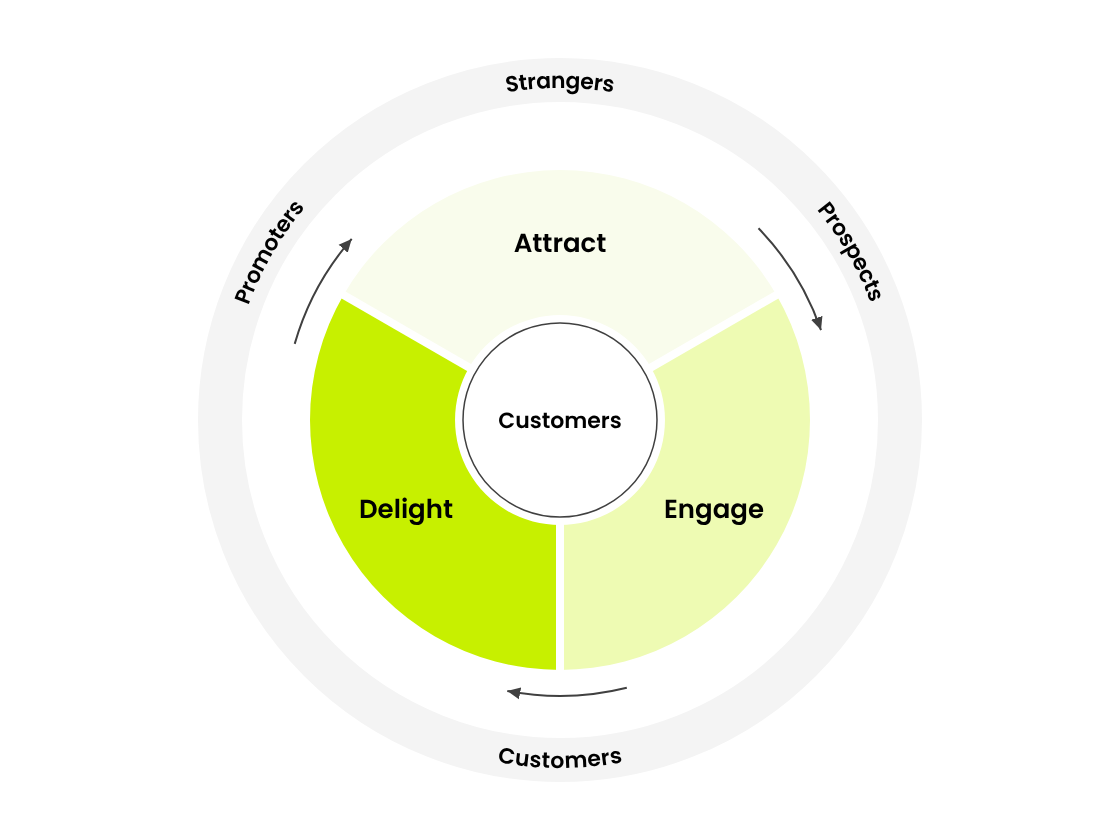
Graphic representation of the Flywheel framework
Stage 1. Attract
This is where the wheel starts. People don’t know the company yet. They have a problem, and they search for an answer, read a review, ask a colleague or ask an AI assistant such as ChatGPT or Google’s AI Overviews.
What is the goal of the company? Be there with something genuinely useful, so people come because they want to, not because an ad interrupted them. Today that also means being part of the answer an AI gives, not only a link in search results.
What the company does? Publishes content, makes it easy to find through search, social media and AI answer engines, and uses targeted ads and social selling to reach the right people.
How HubSpot does it? Its blogs, webinars and HubSpot Academy courses teach marketing and sales for free, and many readers later try the product. HubSpot measures this stage by monthly website traffic.
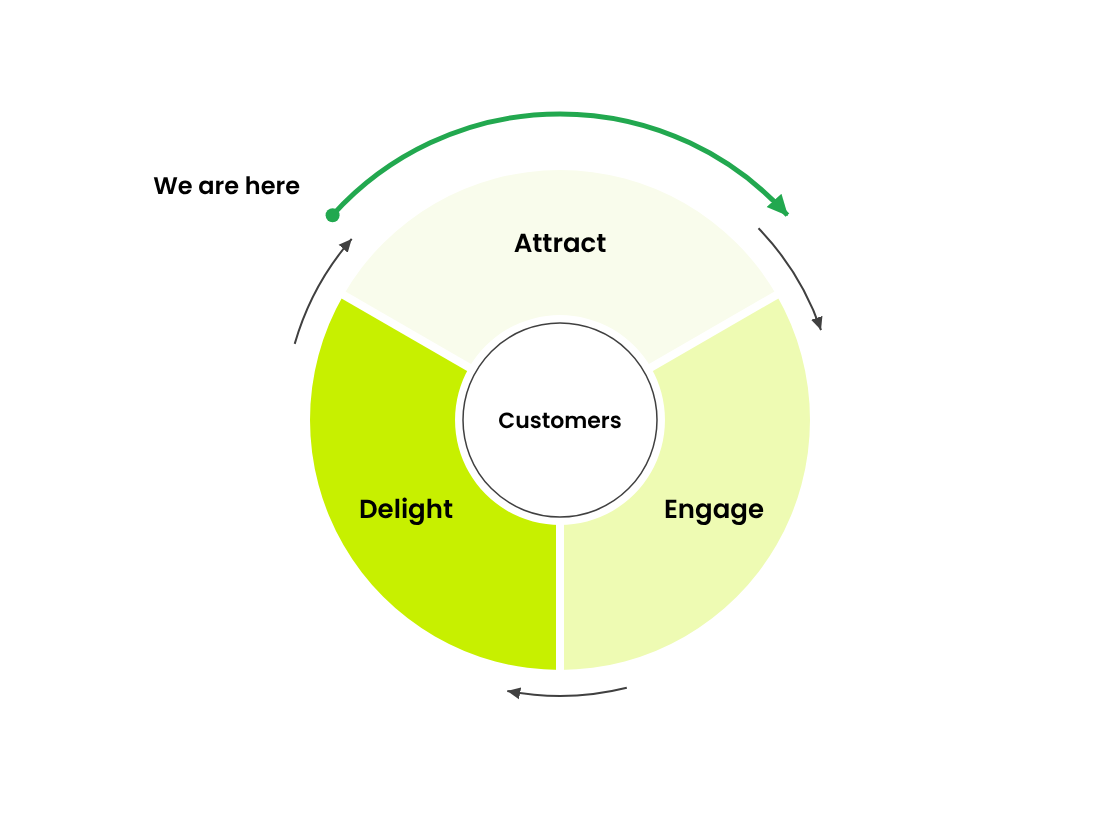
Flywheel attract stage
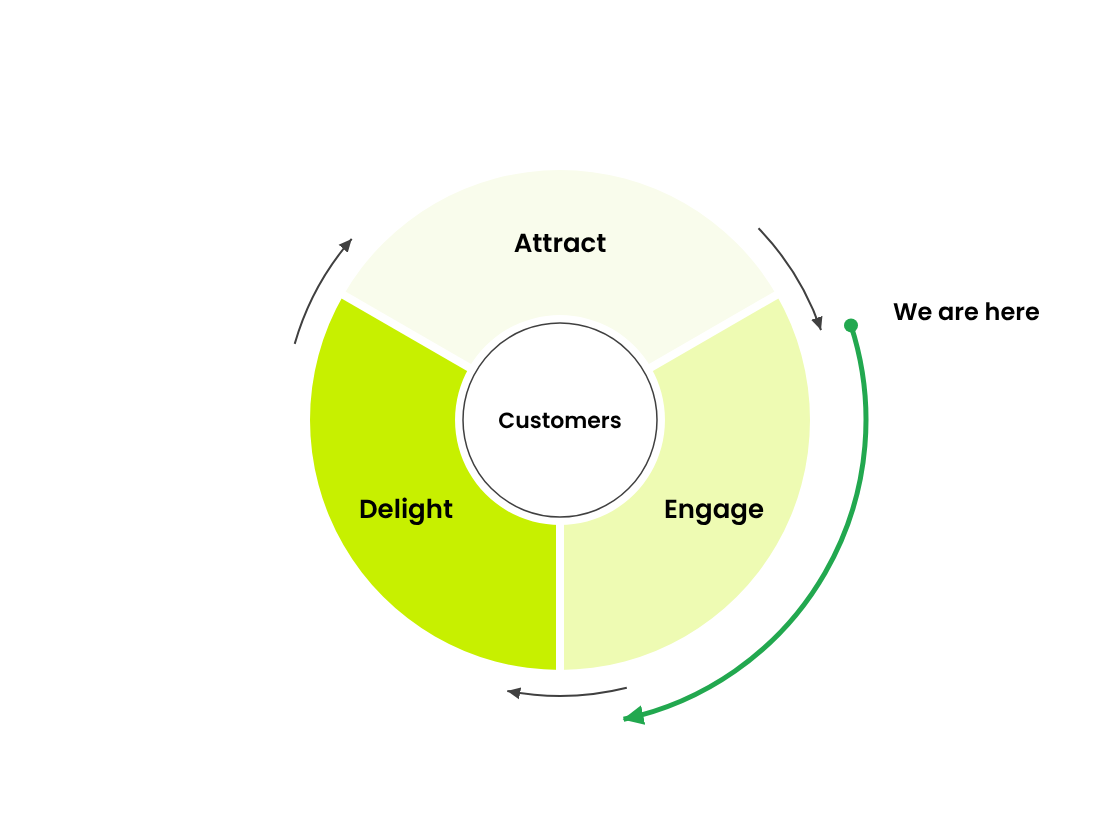
Stage 2. Engage
This is where people start a relationship with the company. They ask questions, compare options and try the product.
What is the goal of the company? Make buying easy and let people move at their own pace, in whatever channel suits them. Every conversation should help them, even if they don’t buy today.
What the company does? Offers chat, email, phone and free trials, and uses personalization, lead nurturing, automation and AI agents to keep every contact relevant.
How HubSpot does it? Free versions of its software let people try the product with no risk and upgrade when they’re ready, so buying never depends on a sales call. HubSpot tracks this stage by how many new free users and paying customers it gains and how many of each it loses.
Flywheel engage stage
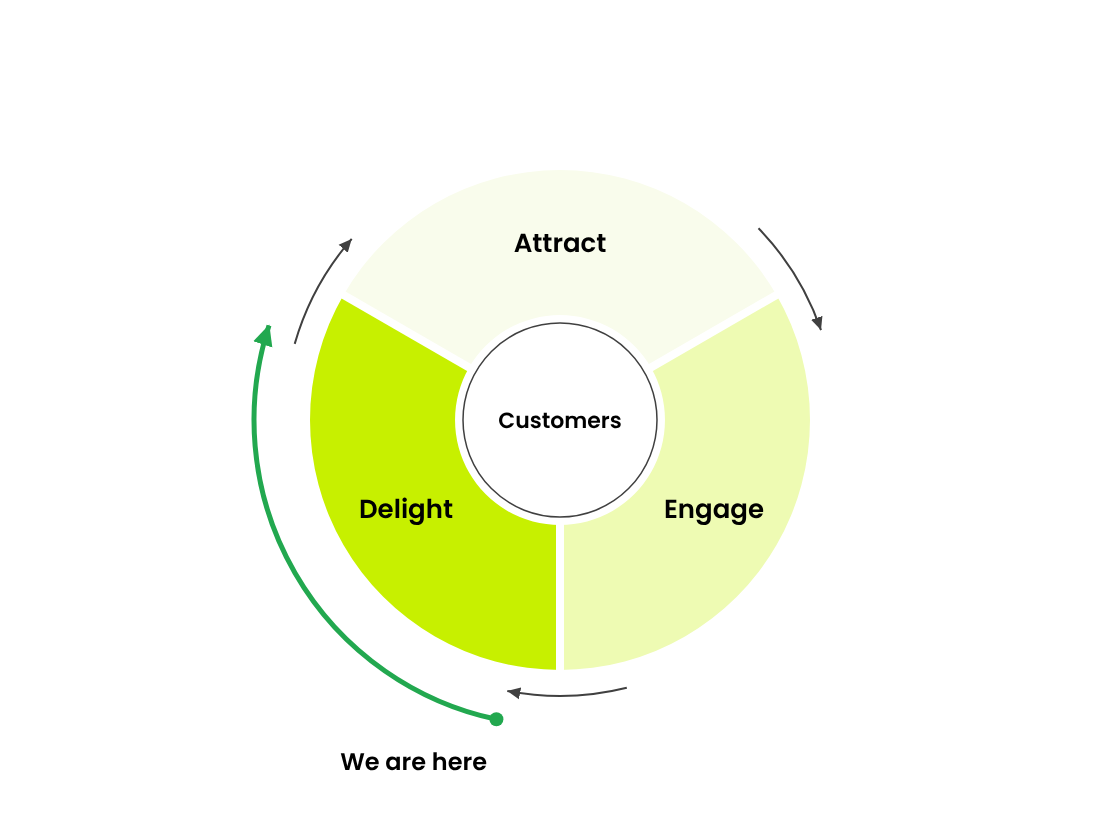
Stage 3. Delight
This is where customers either stay and grow, or leave. They have bought the product, and now they want results.
What is the goal of the company? Help customers succeed, because a customer who succeeds tells others, and those people enter the Attract stage. This is the step that turns a funnel into a wheel.
What the company does? Provides onboarding, self service help, proactive support, loyalty programs and AI support that answers at any hour, and asks customers for feedback.
How HubSpot does it? HubSpot matches help to the customer. Paying customers get a team that guides them through setup, AI agents here also help, free users get lighter support, and everyone has a knowledge base to solve problems alone. Each quarter it asks customers how likely they are to recommend HubSpot and counts how many are promoters.
Flywheel delight stage
Lever 1. Speed
Where to apply it? At the stage where the wheel loses the most people, which shows in the conversion rate between stages. In Attract the typical forces are content, search and paid ads. In Engage they are a free version of the product and buying without a salesperson. In Delight they are customer service, onboarding and a referral program.
When to apply it? Early on, put most force into Attract and Engage, because it takes a lot of effort to get the wheel moving at all. Once it spins, move resources into Delight, because momentum now comes from customers who stay and recommend you.
How HubSpot does it? It measured monthly website traffic, new and lost free users, new and lost paying customers, and promoters. In 2018 it moved force toward Delight with more customer marketing, customer advocacy, onboarding and integrations, and launched a low priced Starter tier that most people bought without a salesperson.
Lever 2. Friction
Where to apply it? At the handoffs between teams, from marketing to sales and from sales to customer service, and wherever people get stuck buying, such as confusing pricing or a sales process that forces them to buy your way instead of theirs. Customer complaints show the outside friction, and slow processes and stuck metrics show the inside friction.
When to apply it? When a metric won’t move despite repeated effort, customers repeat the same complaint, or a process takes longer than it should.
How HubSpot does it? HubSpot removes friction in three steps, in this order.
Automates repetitive work that slows its teams down.
Then it gives teams shared goals, for example measuring marketing on good fit customers instead of on the number of leads, so marketing and sales stop pulling in different directions.
If both steps are not enough, it reorganizes the teams.
Lever 3. Size
Where to apply it? On existing customers. Keep them, and help them use more of the product through more features, more seats or more products. HubSpot calls this adding density to the wheel.
When to apply it? Once customers succeed with the product and the wheel already spins.
How HubSpot does it? It tracked customers added and lost every month and how many became promoters. Its customer Stella started with one HubSpot product in January 2018 and used the full suite by November. That year HubSpot reported nearly 20,000 customers using more than one product, up 90%.
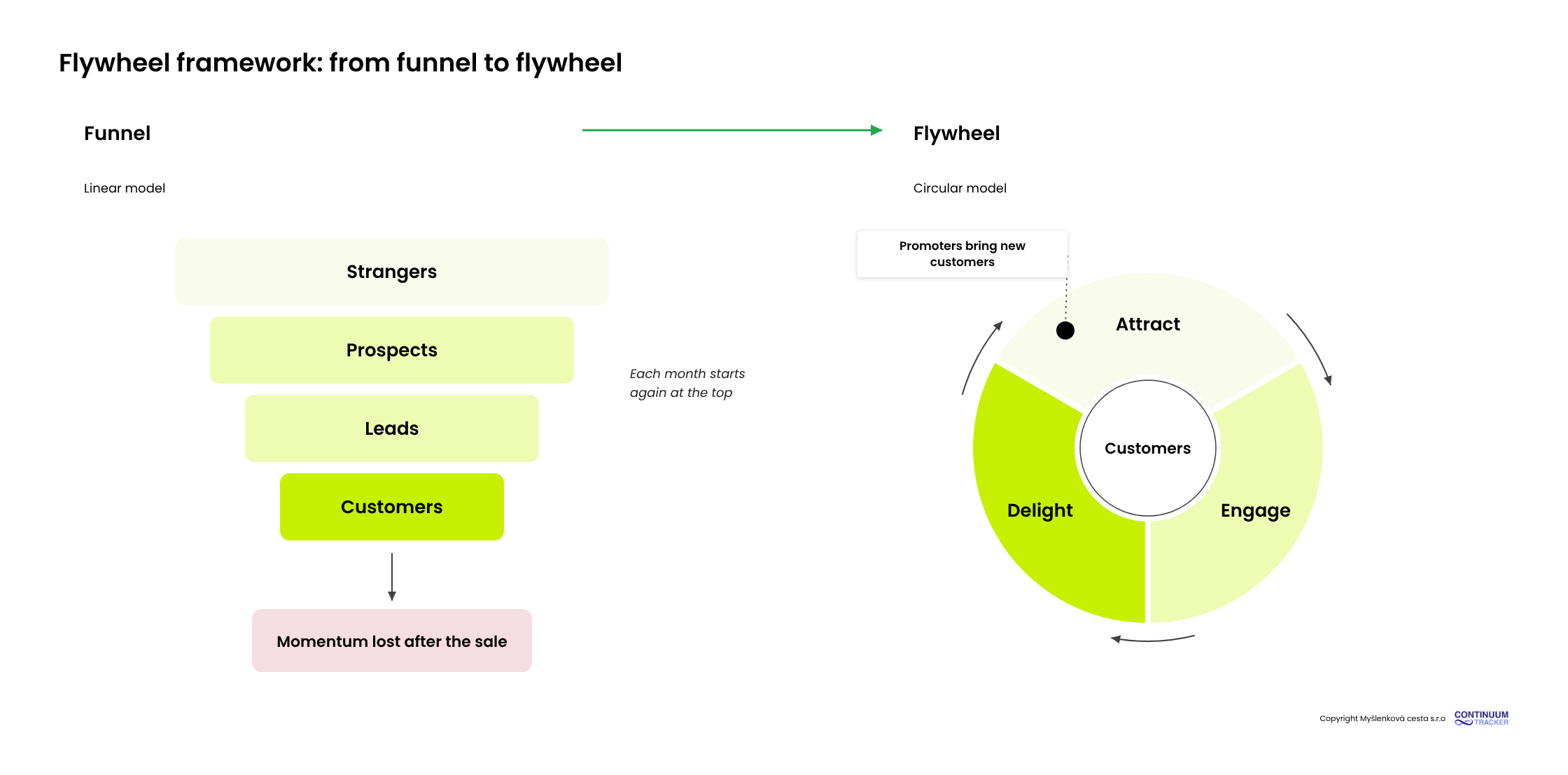
The difference between a funnel and flywheel
A funnel is linear. Strangers become prospects, leads and customers, and then they leave the model. A flywheel is circular. Customers stay inside it and keep it turning.
Keep your funnel charts for single processes such as a signup flow. Each of them is one part of the larger flywheel.
The difference between funnel and flywheel framework
Examplees
Dropbox flywheel
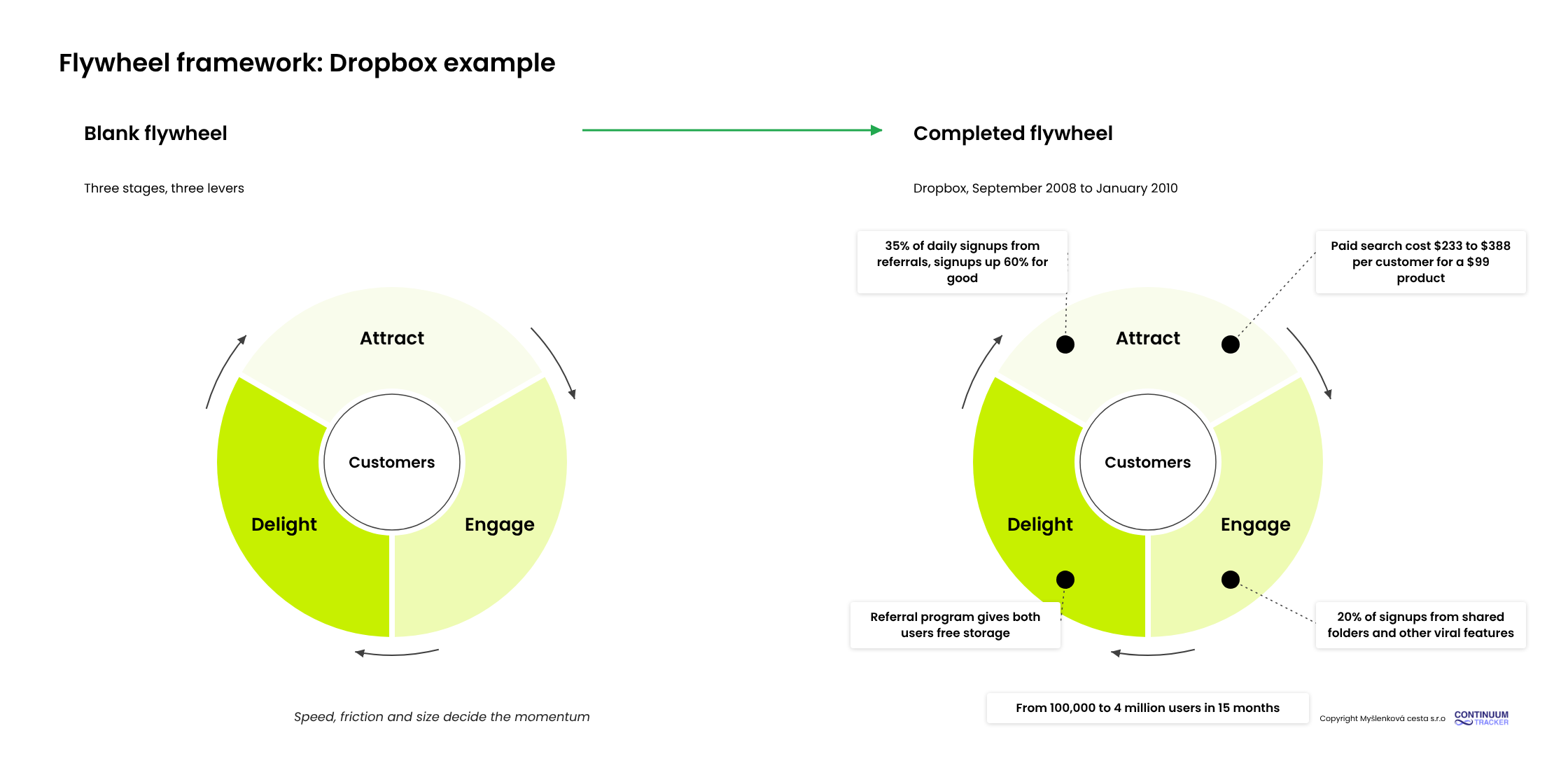
Dropbox never called its model a flywheel, but its early growth shows all three levers with published numbers. Co-founder Drew Houston shared them in his Startup Lessons Learned deck in April 2010.
Friction in Attract. In early 2009 Dropbox tested paid search. Each customer it acquired that way cost $233 to $388, for a product that sold for $99.
Force in Delight. Dropbox built a referral program into the product. Both the existing user and the invited friend received extra free storage.
Delight feeds Attract. The referral program permanently increased signups by 60%. 35% of daily signups came from referrals and another 20% from shared folders and other viral features.
Size. Dropbox grew from 100,000 registered users 4 million 18 months.
Example of flywheel framework on Dropbox growth
HubSpot's flywheel
On its Q3 2018 earnings call Brian Halligan named the move from a funnel to a flywheel as one of two big plays behind HubSpot’s results and called friction “the enemy of any flywheel”. He said the new Starter tier was a big part of how HubSpot was implementing it and that most Starter products were already bought without a salesperson. HubSpot’s Q4 2018 investor presentation has a slide called The Flywheel that tracks traffic and the free users, customers and promoters added and lost.
Attract. HubSpot gave value before asking for anything. It published free blogs, webinars, campaigns and social media content, and offered free HubSpot Academy lessons and certifications. It measured how much its website traffic grew month over month.
Engage. HubSpot offered free versions of its software, so people could try it before they bought and upgrade later. Inside the product it placed upgrade points where a free user could become a qualified lead, and it tracked how many of those leads became paying customers. It counted how many free users joined each month and how many free users and paying customers it lost.
Delight. HubSpot matched support to the customer. Paying customers got an implementation and strategy team, free users got lighter support, and everyone got user guides and a knowledge base. Every quarter it ran a Net Promoter Score survey and tracked how many customers were promoters and how many dropped to passives or detractors.
Friction removed. HubSpot made free software the entry point, added channels that let people connect with it right away instead of later, built a sales process that solves for the prospect, and invested in a broad range of customer education.
HubSpot ended 2018 with over 56,500 customers and $513 million in revenue. On June 30, 2026 it had 306,446 customers.
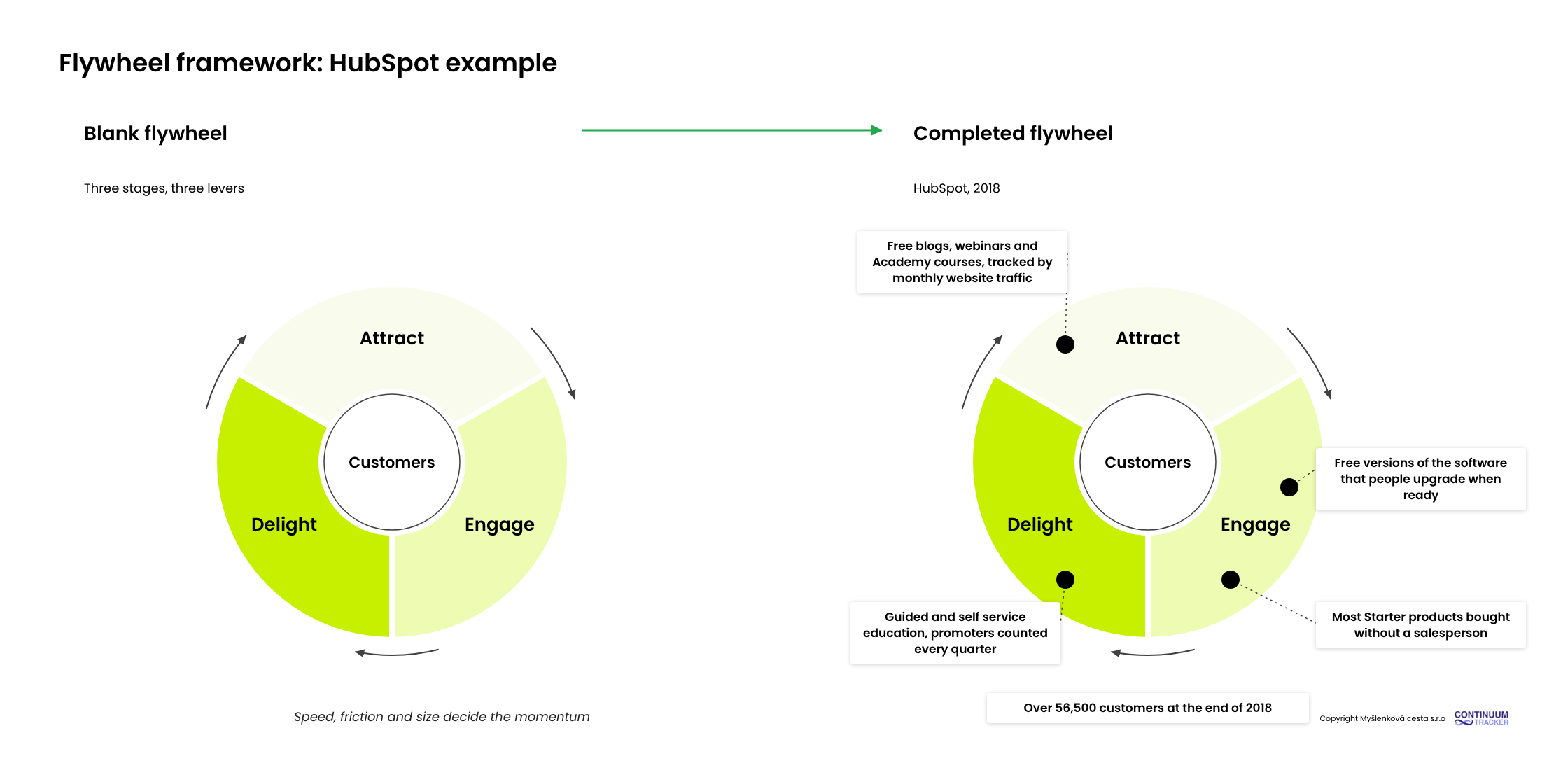
Example of flywheel framework on HubSpot growth